Overview
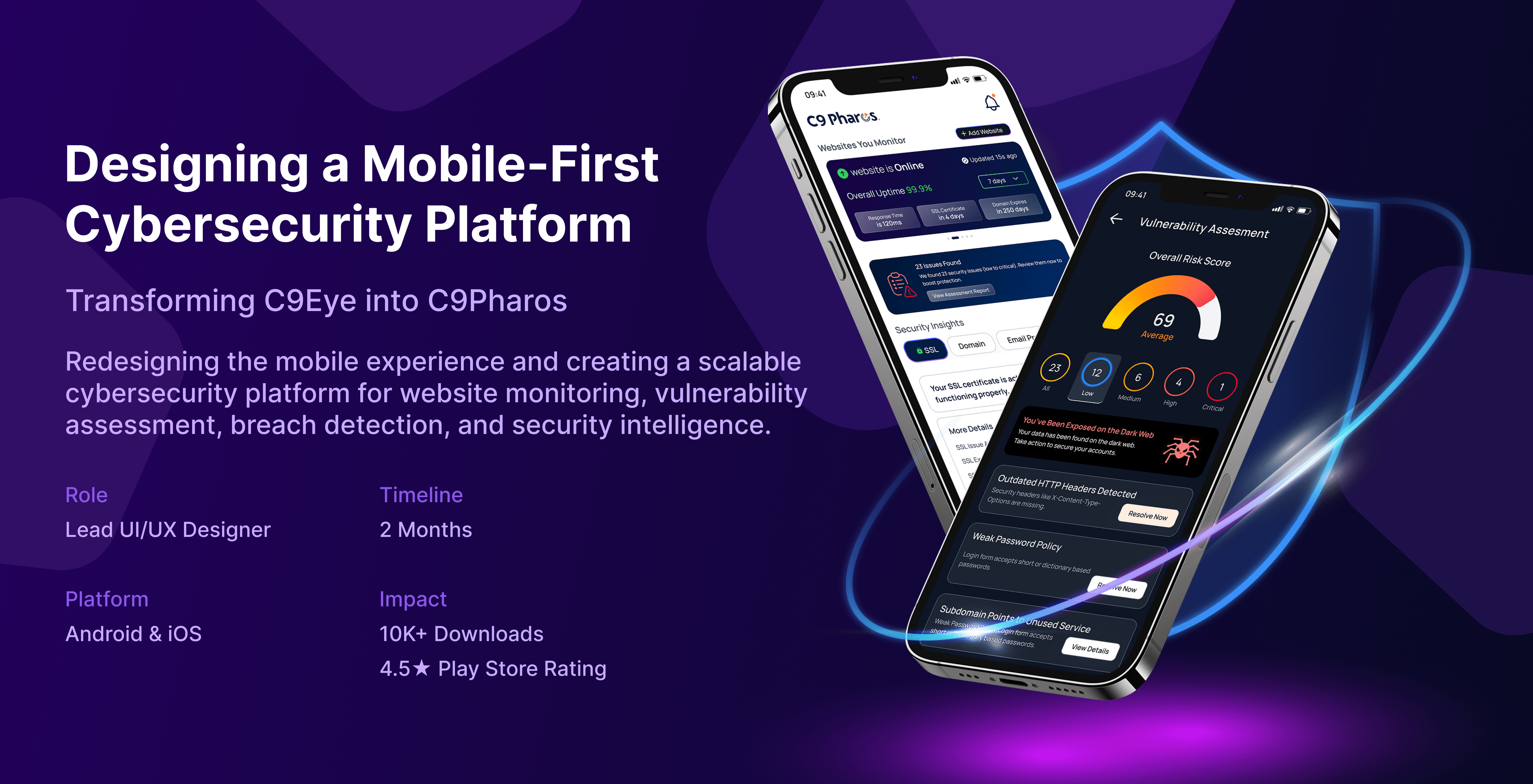
C9Pharos is an enterprise cybersecurity platform designed to help organizations monitor website health, SSL certificates, uptime, domain information, vulnerabilities, email breaches, and security intelligence from a single application.
End-to-End Design
Complete ownership of the Mobile UI/UX Design lifecycle from research and strategy to high-fidelity component handoff.
SaaS Complexity
Transformed complex cybersecurity metrics and technical jargon into approachable, instantly scannable mobile insights.
Brand Evolution
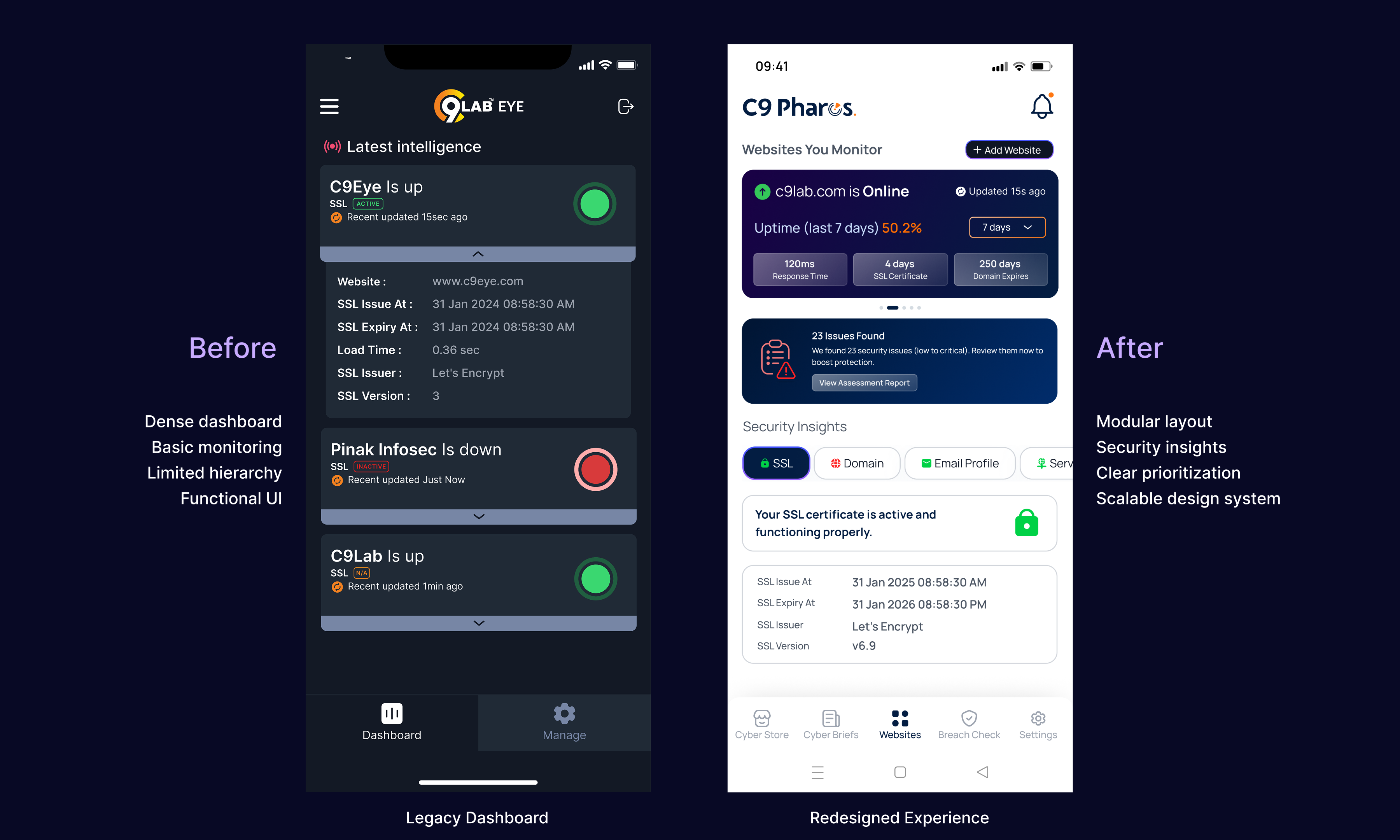
Redesigned the entire ecosystem to support the successful transition from legacy C9Eye to the expanded C9Pharos brand.
The Challenge
Cybersecurity products often overwhelm users with technical terminology, fragmented workflows, and data-heavy dashboards. Users were forced to switch between multiple disjointed tools to monitor critical infrastructure.
The Goal: Not just designing beautiful screens, but transforming complex security data into a unified, instant-read mobile experience that IT professionals could understand within seconds.
My Role
As the sole designer on the project, I was responsible for bridging business objectives, technical constraints, and user needs to deliver a cohesive product.
- UX Strategy
- Information Architecture
- Wireframing
- Visual UI Design
- Design System
- Prototyping
- Dev Handoff
- Design QA
Design Process
01. Define
Problem framing
02. Context
Architecture
03. Wireframes
Low fidelity
04. Interface
High fidelity
05. Prototype
Interactions
06. QA
Implementation
Product Evolution
The application originally launched as C9Eye. As capabilities scaled far beyond basic uptime checks into a holistic cybersecurity ecosystem, it required a complete brand and UI evolution to become C9Pharos.
C9Eye
Website MonitoringBrand Evolution
Expanded FeaturesC9Pharos
Cybersecurity PlatformInformation Architecture
To prevent nested navigation fatigue, I established a flat hierarchy prioritizing core experiences, ensuring critical data is immediately accessible.
UX Strategy & Features
Decreasing Time-to-Value
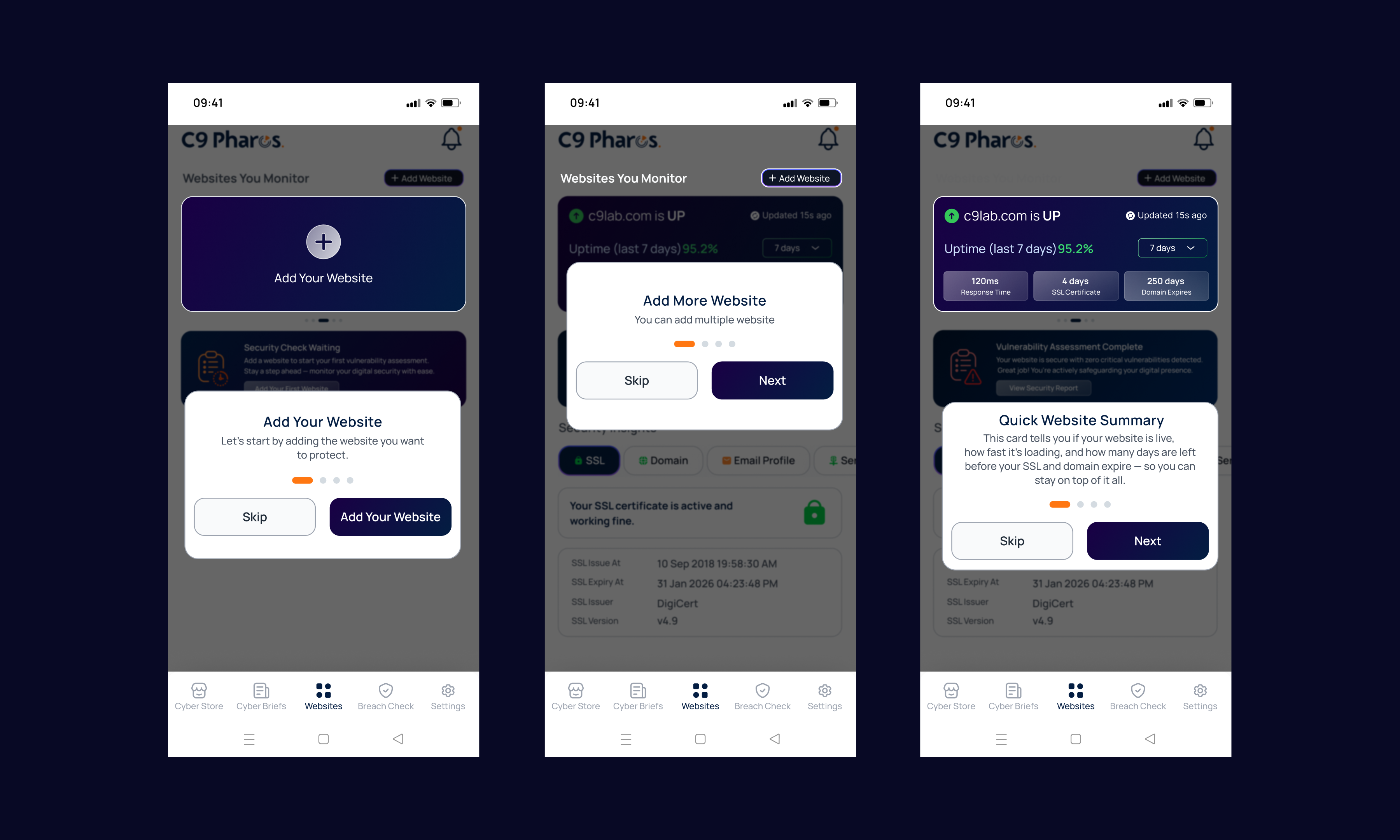
Gradual Onboarding
Instead of overwhelming users with every capability at once, the onboarding introduces one core feature per screen. This progressive approach helps users understand the product faster while reducing cognitive load.
Design Reasoning: Progressive disclosure improves feature discoverability, builds confidence, and reduces first-session friction.
Actionable insights at a glance
Dashboard & Monitoring
The dashboard is engineered for split-second decision-making. Eschewing complex data tables, critical information is abstracted into highly legible, reusable status cards.
From raw data to remediation
Vulnerability Assessment
Security reports notoriously paralyze users with lengthy technical findings. I redesigned this flow to aggregate data into a top-level Overall Risk Score, supported by color-coded Severity Categories.
Design Reasoning: Visualizing risk allows users to prioritize critical remediation immediately, while nested panels house the granular, actionable resolution recommendations for developers.
PwnCheck Experience Design
PwnCheck enables users to scan their emails against known public data breaches. This flow was meticulously designed around three distinct emotional states to manage user anxiety and drive clear action.
1. Search State
A hyper-focused, minimal interface designed solely to encourage input. Extraneous elements are removed to streamline querying.
2. Safe State
Delivering positive reinforcement. Uses distinct, reassuring green visual cues and calming copy to confirm data remains uncompromised.
3. Breached State
Designed to prevent panic. Uses strict visual hierarchy to highlight what data was leaked and provides immediate mitigation steps.
System & Language
To ensure extreme consistency across development, I engineered a highly scalable design system balancing technical credibility with SaaS approachability.
Key Takeaways
Designing C9Pharos reinforced the critical balance between technical depth and mobile usability in enterprise software.
System Scalability
Built a foundation ensuring future cybersecurity modules integrate seamlessly without breaking existing UX patterns.
Complex Simplification
Learned to aggressively abstract massive datasets into actionable, progressive layers of disclosure.
Visual Hierarchy
Relied heavily on typography and strict color status conventions to guide user attention to critical threats.
End-to-End Delivery
Successfully managed the product pipeline from initial problem definition through to developer QA as a solo designer.